


Dear readers,
You might have noticed that The Church and AI has been extremely quiet for the past year or so. In part, that’s because in many ways, the AI landscape hasn’t changed in any particularly earth-shattering ways. Of course, the technology is improving as we expected; “AI slop” is flooding the digital space as we expected; and in the race for dominance and profitability, ethical boundaries are being tested, as expected.
But the big picture hasn’t changed too much, beyond what appears to be an increasingly ambivalent or outright hostile sentiment towards AI’s ubiquity.
When I wrote The Church and AI: Seven Guidelines for Ministry on the Digital Frontiers, my intention was to formulate some ideas that would at least survive the rapid changes of the near future. Many of the thoughts on this Substack inspired the book and thus have not changed.
However, there are other reasons for my lack of activity here.
Last year, I had the opportunity to lead our church family through something of a “relaunch” process, which involved setting new vision, values, and strategies, renovating our building, and consolidating those changes. By God’s grace, our little church ended the year in awe of what the Lord had done on almost all fronts. Of course, this is wonderful news, but also incredibly exhausting.
Rather than focusing my thoughts on AI, much of my attention has been on a simple question:
“What makes for a flourishing church culture?”
This has been a crucial question for us as a church family, and worthy of our time. You don’t have to look far to find endless sprawls of books promising 10x growth or the latest strategies and techniques to be the next megachurch, but my concern is that, so often, such books focus on the “doing” rather than the attitudes that inform the actions.
For that reason, I want to introduce you to my new book, The Shortbread Gospel: Three Ingredients for a Flourishing Church Culture.

The idea is simple:
Shortbread is a delicious, moreish and simple treat that requires only three crucial ingredients: flour, sugar, and butter.
Like shortbread, the Church is at its delicious, moreish, God-honouring best when it contains a healthy balance of three crucial ingredients: Word, Spirit, and relationship.
Let me be candid with you: I’m growing increasingly disillusioned with the “industry” of Western Christianity. I’m not interested in jostling for status or profit; I just want this book to be a blessing. As such, the paperback is priced at cost, and the Kindle version is even cheaper. If you still can’t afford it and would like me to send you a PDF, let me know by commenting below or contacting me another way.
Below, you’ll find a few reviews from early readers, and then the entire first chapter.
And that’s it. That’s all you’ll hear from me about The Shortbread Gospel.
If you’d like to buy it, click on the image above or just search for it on Amazon.
Readers, thank you for allowing this brief (and singular) divergence from artificial intelligence-related content. I consider it an enormous privilege that you have chosen to follow this Substack, and I certainly do not take it for granted. May God richly bless you in whatever the rest of 2026 has in store for you!
PRAISE FOR THE SHORTBREAD GOSPEL
“The Shortbread Gospel is a refreshingly grounded (and surprisingly witty) invitation to return to the three quintessential ingredients of a life fully alive in Christ—Word, Spirit, and Relationship—while quietly exposing the hidden dangers of letting our souls drift from God. Gently unsettling yet tempered with hard-won wisdom and humility, The Shortbread Gospel reminds us that spiritual maturity is not about achievement, but about learning to linger longer at the table of God’s generosity.”
“The Shortbread Gospel is a timely and insightful read for churches and believers alike who find themselves asking: “What is missing?” in their fellowship and life together as the body of Christ. With warmth and clarity Dave Betts presents the essential “ingredients” needed to cultivate a healthy, Christ-centered community - much like the simple elements that make shortbread both rich and sustaining.
The book is easy to follow and deeply engaging, offering both biblical truth, personal stories, and memorable anecdotes that bring its message to life. Bett’s thoughtfully shapes his ideas in a way that stirs renewed passion for a deeper relationship with Christ, strengthens one’s grasp of truth, and encourages meaningful fellowship among believers.”
“The Shortbread Gospel is a thoughtful and engaging book whose central metaphor is far more than a novelty. The shortbread framework is memorable, and genuinely helpful for understanding the essential elements of a healthy church: Word, Spirit, and Relationship. This relevant and insightful book fills a real gap in how church is commonly understood and experienced. I highly recommend it to any Christian seeking a healthy church, and even more importantly, to any Christian who is committed to becoming a healthier contributor within their local church body.”
CHAPTER 1: When the Church Feels “Off”
I stumbled into a life of ministry almost two decades ago. In those years, God has given me the privilege of worshipping in well over a hundred churches, with thousands of believers from a wide range of denominations, traditions, and cultures around the world. I’ve joined with Jesus’ followers to gather around a fire and worship the Lord in an ominous-looking former castle in Poland (where is the “castle Church movement, by the way?). I’ve worshipped in a half-a-billion-dollar Singaporean megachurch where the security team was three times the size of the Polish castle church, a picture of opulence with a literal shopping mall beneath its extravagant sanctuary. Actually, before God broke into my life, I helped construct a little church building a few miles out of Nairobi, Kenya. As an avowed teenage atheist, I was furious about carrying cinder blocks and heavy bags of concrete for what became a little dark shack covered with nothing more than a few sheets of corrugated metal. I fixed my gaze on the dusty floor as a small group of Kenyan believers danced, clapped, cheered, and praised the Lord for our help in completing their church. I didn’t know it then, but building God’s church was about to become my life’s mission.
I’ve joined fashionable believers in New York City’s theatres, where time is money. I’ve stood out like a sore thumb as a lone, naïve Brit among an ocean of cowboy boots in farming communities in the heart of the snowy prairies (my particular favourite was the church in Gem, Alberta, where the entire city’s population is a whopping twenty-nine people). From Chicago to Świdnica, Brisbane to Bradford, Whistler to Winchester, Klaipeda to Korçë, and Portsmouth to Pittsburgh, one of the great joys of my life has been the opportunity to see the Body of Christ expressed across the globe. It’s a privilege I don’t take for granted; indeed, it’s hard to do anything but marvel at the way God moves in such varied and remarkable diversity.
But, as you’ve probably guessed by the chapter’s title, it’s also true that wherever they are and however they look, sometimes churches can miss the mark, falling short of the standards and practices God calls them to uphold. It’s not surprising; some estimates suggest that as many as 31% of the world’s population is Christian. Something is bound to go wrong! Within this vast population of believers, myriad age demographics, cultural systems, language norms, denominational affiliations, and broader societal practices vie for influence. Whatever our background, the fact that the global Church is composed of people means that, while it’s perfect in theory, it is almost always imperfect in practice. Of course, when there’s abuse, scandal, splits, or blatant heresy, there’s obviously a big problem somewhere in that church. But often, before arriving at such an extreme, there are significant “tells.” You might have noticed it: something feels a little “off.” Perhaps it feels as though the church isn’t totally wrong, per se, but they aren’t quite right either. To explain what I mean, here are a few examples that I’ve personally encountered (with names changed to protect the people involved):
Scenario 1: The Overzealous Ministry Team Member
It’s an evening service where several churches have gathered together. A guest preacher has just finished his second sermon of the day. The response is profound; several students, moved by the moment, rush to the front of the room to receive prayer for the next season of their lives. As reflective music plays in the background, the guest preacher and accompanying ministry team work their way through the hordes of tear-spilling teenagers, making sure to pray with each one. Dylan, a new member of the ministry team, is excited about what’s happening…and possibly a little overzealous. He moves from student to student, placing a hand on their forehead, before—quite literally—pushing them to the ground “in the Spirit.” It’s clear to most present that there is nothing Spirit-led about his actions, and one of the more seasoned leaders intervenes. “I don’t understand,” Dylan says. “I’m doing what my pastor showed me to do.”
Scenario 2: First Real Contact with the Pastor
Johnny has recently moved cities. He’d previously attended Super-Mega-Global-Church, but after a chance opportunity to reconnect with old friends, he’d been invited to check out Relational Church for the first time. From the moment he walked through the door, something felt different. The church was extremely welcoming. It felt as though the pastor was genuinely interested in getting to know him, asking many questions, even inviting him to join his family for dinner that night. Johnny had never experienced anything like this before. He’d attended churches for his whole life, but they were all just like Super Mega Global Church. Connection seemed to be a staffed ministry department rather than a way of life. In fact, as he drove home, Johnny realized something unsettling and beautiful all at the same time. In one afternoon, he’d spoken more with the pastor of Relational Church than he ever had with any of his previous pastors combined. And just maybe, there was something significant about that.
Scenario 3: Barking up the Wrong Tree
It’s the final night of a major Christian conference. The crowd is electric, filled with thousands of inspired and encouraged believers ready to worship one last time before heading home. The arena, which has hosted celebrities and even royalty, now resounds with emphatic songs of praise to the King of Kings and Lord of Lords. As the final chorus fades, the lights dim and the host invites everyone into a moment of reflection. A hush falls across the room, as over five thousand people stand in complete silence, overcome with awe-filled reverence before God.
And then, it happens.
The silence is broken.
Gerald—an aging saint who’d attended the conference alone—suddenly feels “led by the Spirit” to bark like a dog. Not once, not twice, but for a full five minutes. Around the arena, a few voices join in: lion roars, tearful shrieks, and guttural cries fill the space that had, just moments earlier, been palpable with the presence of the Lord. Were some in need of deliverance? Quite possibly. Was Gerald one of them? He certainly didn’t think so. I was young and interested [read: terrified] by what was happening, so after the gathering, I waded through the sea of people to ask him what he felt was going on in that moment. He simply replied, “The Holy Spirit was moving, young man. The Holy Spirit was moving.”
Scenario 4: The Lonely Visitor
It’s an unusual weekend for Ryan.
He’s a carpenter, working a job about six hours from home. Since he can’t make it back for the weekend, he decides to find a local church, because—to his credit—even on the road, he doesn’t want to miss an opportunity to gather with God’s people. After a quick Google search, he lands on Together Church. It has rave reviews.
Ryan’s been to plenty of churches over the years; in fact, he even spent a few years as a pastor himself. But that doesn’t stop him from feeling that familiar knot in his stomach that comes with walking into a new place alone. With a deep breath, he pulls into the parking lot, pushes open the heavy front doors, pours himself a coffee from the unmanned (and ironically named) Welcome Station, and slips quietly into a seat at the back of the sanctuary.
He’s fifteen minutes early and looking forward to meeting some new people.
No one speaks to him.
People trickle in. Conversations fill the room, but not with Ryan. The service begins. The worship seems to be heartfelt, and the sermon is strong; it’s a rousing message about the Greatest Commandments: “Brothers and sisters, we must love the Lord our God with all our heart, soul, and mind, and love our neighbour as ourselves,” the pastor yells while thumping the pulpit with characteristic gusto. After the final song and benediction, the congregation begins the familiar shuffle to gather coats, collect kids, and connect in small clusters around the room.
Ryan stands for a few moments, hopeful. He smiles at people as they pass by and occasionally receives an acknowledging smile or nod. He even tries edging toward a friendly-looking group deep in conversation.
They don’t pause.
Or make room.
Or even glance his way.
Eventually, Ryan gives up. He leaves through the same doors he entered, finishes his now-cold coffee, and drives away. He hadn’t spoken a single word to another human being during the entire church gathering.
(Tragically, I could share at least twenty more stories like this one. I suspect you might be able to, as well.)
Scenario 5: The Walled-In Church
Simon and Katie moved to the city from South Africa just over two years ago. They were deeply saddened to leave their church family behind, but genuinely excited at the possibility of joining a new one. Even before boarding the plane, they’d done their homework. In the six months leading up to the move, they’d researched nearly every church within twenty miles of their new home—close to a hundred individual church communities. They watched sermons online, compared statements of faith, and studied ministries and music styles. It was an important decision they wanted to get right. Out of all the churches they looked at, one stood out:
People Matter Church.
Simon and Katie were so eager to attend that they showed up on their very first Sunday in the country, still jet-lagged, but full of hopeful expectation that they’d find “their people.”
For the next two years, they hardly missed a service. They loved the music. They loved the teaching. They loved the energy, the excellence, and the sense of Sunday community that filled the building every week.
Then one weekend, something unexpected happened.
A new couple, Kyle and Hannah, had just moved to the area and, like Simon and Katie a few years earlier, were visiting People Matter Church for the first time. After the service, they struck up a conversation, and by the end of it, Kyle said, “Hey, we’d love to invite you to our place for dinner sometime.”
It was a simple invitation, but a profound one.
As they were driving home, Simon and Katie realized that in two years of faithful attendance at People Matter Church, that was the first time anyone from the church had ever invited them to their home, and this was the couple’s first Sunday!
Why had it taken a brand-new couple to extend the first hand of friendship? Why did the church seem to exist only within the walls of the building during programmed events? Had it been their responsibility alone to initiate church relationships? They loved People Matter Church, but couldn’t help wondering: which people mattered—and when?
Scenario 6: Information but not Transformation
Jenny and her family have attended the same church for generations: Bible First Church. On paper, it checks every box. The sermons are doctrinally sound, intellectually rich, and at least an hour long (“as they should be,” Jenny thinks). The pastor meticulously unpacks every theological nuance, parses every Greek verb, and never fails to quote at least one Church Father, or Great Reformer, or the pièce de résistance: something from C. S. Lewis.
Every Sunday morning, the congregation sits in their orderly, pre-planned rows, with Bibles open and notebooks ready, eager to learn, and excited for the evening’s upcoming two-hour deep dive into Ezekiel 6. The music is traditional, reverent, and refreshingly predictable (“as it should be,” Jenny thinks). Each week, she drives home with her head full, but her heart oddly quiet. She understands the original meaning of the Greek word markarios and its impact on one’s interpretation of the Beatitudes in Matthew 5. She can hold her own in a conversation about the historical-critical and historical-grammatical methods. And don’t even get her started on the eschatological Millennium.
But lately, something feels off.
Her intellect is stuffed full of information, but her soul still feels hungry. Despite all of the knowledge she’s accumulated, deep down, Jenny knows she’s not living for Jesus the way Scripture calls her to. Around her, she sees the same pattern: friends who would never miss a church event, but curse at their coworkers without a second thought; families who explode in anger behind closed doors; believers who mock other churches for the slightest doctrinal difference.
Although Jenny doesn’t know it yet, her pastor will be fired next week for having an affair.
It all looks so right on the surface, and yet somewhere in all the academic knowledge and study, something vital seems to be missing. Jenny can’t quite name it yet, but she’s beginning to suspect that all this information isn’t moving from her church family’s heads to their hearts.
And that’s an issue.
THE PROBLEM
If you’ve never encountered a scenario like those listed above, congratulations. You’ve found the perfect church! For the rest of us, though, at least some of these stories probably sound a little too familiar.
What’s going on?
Believe it or not, the answer is in . . . shortbread.
If you feel a sudden urge to close the book, let me explain (although you might be shocked to look at the front cover again). Shortbread is a simple, centuries-old Scottish treat that pairs particularly well with a cup of tea. What makes it so remarkable is its simplicity: it only needs flour, butter, and sugar. That’s it. No secret techniques or complicated recipes, and it doesn’t take a candidate for MasterChef or The Great British Baking Show to make it.
Perhaps you’re a pastor or church leader. If so, chances are high that you’re already buried under a stack of books that promise the world. Maybe this one feels like just another to add to the pile. Each of those books offers its own “secret sauce” for preaching more effectively, running small groups more meaningfully, growing your church exponentially, evangelizing more boldly, guiding your staff inspirationally, and, of course, leading like Jesus (often in a manner that looks curiously like a modern-day CEO). You may have programs for your programs, strategies for your strategies, and a ministry operation that hums like a well-oiled machine. You’ve read about (or implemented) a million different ingredients and techniques for the complex, MasterChef-styled smorgasbord that you call church. That’s not necessarily a bad thing. Praise God for those resources available to us!
But here’s the problem: the more complex the recipe, the easier it is to lose track of an ingredient or two along the way. And when that happens, the end result—no matter how polished it looks—starts to taste a little “off.”
This book is a call to return to the basic recipe that defines a healthy church culture; a call to rediscover the foundational ingredients of what it means to be the Church living out its mission. You won’t find a ten-step plan to supercharge your ministry, or another checklist for achieving success in Jesus’ name. The premise is far more straightforward than that: in most cases, when a church feels “off,” it’s because one of three vital ingredients is deficient or missing from God’s Church.
That’s the heart of what I call the Shortbread Gospel.
After years of observing and connecting with churches across numerous denominations and cultures, I’ve become increasingly convinced that the biblical model for living in (and living out) the Good News of Jesus as the Church depends, much like shortbread, on three core ingredients.
Where shortbread only needs flour, butter, and sugar, a healthy expression of the Church requires a careful balance of Word, Spirit, and Relationship.
If one ingredient is missing or out of balance in a shortbread recipe, what comes out of the oven might still look like that delicious Scottish delicacy, but it won’t taste like it. In the same way, when one or more of these ingredients is missing from the life of the Church, it may still look like the body of Christ, but something will feel “off.” You can sense it. You can taste it.
Something essential is missing.
Like you, I naturally lean toward a particular theological framework and denominational background. But the Shortbread Gospel transcends those boundaries. Whether we identify as charismatic, cessationist, conservative, liberal, Baptist, Reformed, Pentecostal, Methodist, Anglican, New Frontiers, or any other stream of the family of God, we need a healthy balance of Word, Spirit, and Relationship in our personal and corporate faith.
Before we go any further, I must express deep gratitude to those who have walked this path before me. Depending on your background, you may already be familiar with the phrase “Word and Spirit.” Though it’s a biblical idea as old as the Church itself, it gained fresh language during the Charismatic Renewal of the 1970s and 1980s, and became a defining mark of New Frontiers, a movement of churches I have had the privilege of serving in for much of my ministry life. And yet, with the utmost love for those who helped recover this ancient and vital posture, I’ve grown increasingly convinced that something is still missing.
Word and Spirit alone, as glorious as they are, do not fully express the richness of God’s design for His Church. There’s a third strand that holds the others together: Relationship.
The purpose of this book, then, is simple: to help us recover the biblical balance of Word, Spirit, and Relationship as the foundation of a healthy, Gospel-driven, 21st century church. When these three ingredients work together, our faith becomes rich, vibrant, and whole. But when even one fact is missing or deficient, the imbalance soon starts to show.
• The Word of God without the influence of the Holy Spirit can become rigid and intellectual.
• Pursuit of the Holy Spirit without a deep grounding in the Word of God can result in an unstable, shallow faith. At worst, this expression of faith operates outside the realm of biblical truth.
• Word and/or Spirit without relationship risks becoming either legalistic or performative (or both); Sundays become a show or an “experience” rather than an opportunity for deep connection with God and with people.
We can visualize this as a Venn diagram:
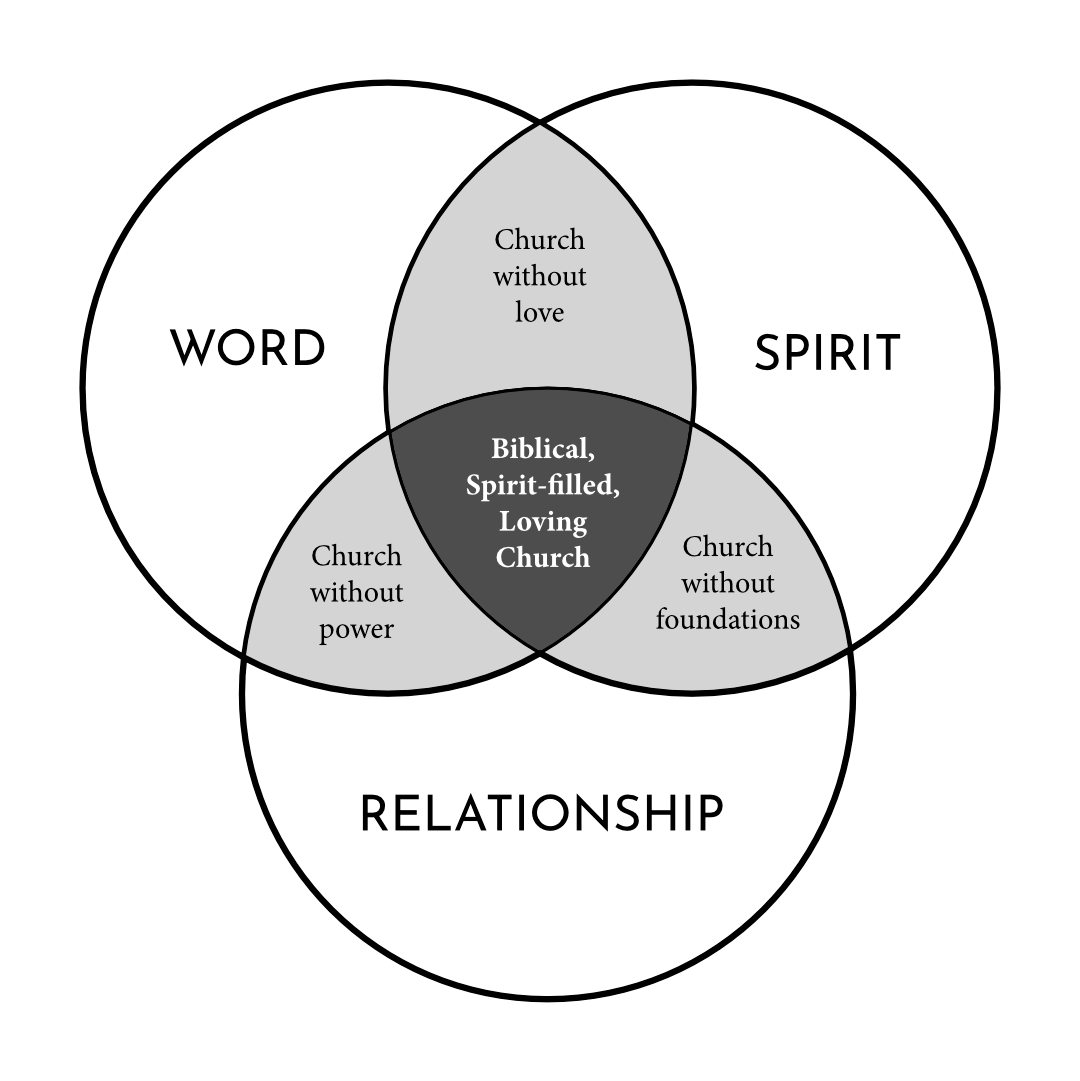
At the center of this image lies the outworking of the Shortbread Gospel: a Biblical, Spirit-filled, deeply relational and loving Church. It’s a community that:
Lives entirely in the reality of Jesus’ death, resurrection, and ascension;
Passionately pursues the truth of God’s Word;
Moves in the power, presence, and guidance of the Holy Spirit;
Loves deeply for the glory of the Lord of All, creationwhile fulfilling His Great Commission.
In scenario one, we met Dylan, an enthusiastic ministry team member who would physically push people to the ground as he prayed for them. His intentions were undoubtedly sincere, but his expression of faith was detached from Scripture. He and his pastor were pursuing an artificial experience of the Spirit because their ministry had become untethered from the Word of God.
The same was true for Gerald, the passionate worshipper who, “in the Spirit,” felt compelled to bark like a dog for five minutes (for reasons that still escape me). Over the years, I’ve encountered similar extremes: people praying for coins to stick to walls, for “glory clouds” to descend (apparently, they’re purple), or even engaging in the patently unbiblical practice of grave soaking—often, neglecting the Scriptures in their pursuit of the supernaturalattemptsto chasethe supernaturalwhile . When we pursue the Spirit without the foundations of the Bible, anything can be justified by the well-meaning but sometimes perilous phrase, “The Spirit told me to,” even if it’s patently unbiblical.
In the second scenario, Johnny visited a new church where the pastor took a genuine interest in getting to know him. For Johnny, it was startling; he’d never had more than a brief handshake with a lead pastor before. That in itself should make us pause. Regardless of a church’s size, if shepherds have no time—or desire—to be with their flock, something fundamental has gone wrong.
The same relational deficit is evident in Ryan’s story, where no one greeted him during his visit to Together Church. In fact, he returned the following week and had the same experience. Not one “hello.” That silence speaks volumes about Together Church’s culture.
Likewise, it’s disappointing to meet people like Simon and his wife, who attended the same church for two years without building any genuinely deep connections. Of course, some element of the blame might be placed on them, but clearly, despite all the great things happening at the church, something was missing in its approach to relationships.
Jenny’s situation in scenario six paints a picture of a church deeply devoted to Scripture yet disconnected from both the Spirit’s sanctifying work and authentic community. The result? A gathering of knowledgeable but grumpy, judgmental, and spiritually stagnant believers. Even the pastor, for all his theological precision, didn’t allow the truth to travel from head to heart; the knowledge that filled his mind didn’t impact his character, leaving him vulnerable to the sins he preached against, including the lure of adultery.
The importance of Word, Spirit, and Relationship is vital:
1. Word and Relationship without the Spirit risks producing a church without power.
2. Spirit and Relationship without the Word of God risks producing a church without foundations.
3. Word and Spirit without Relationship risks becoming a church without love.
For too long, the global Church—or at the very least, large swathes of the Western Church—has allowed itself to bake shortbread with missing or unbalanced ingredients. If some of these stories sound familiar or even painful, take heart. Feeling that something is “off” is not necessarily a sign that the Church is failing; it’s an invitation to return to what makes the Church the beautiful Bride of Christ. The center of the Venn diagram is not some new program or radical new strategy we’ve just unearthed; the Shortbread Gospel is both simpler and more complicated than that. It’s a signpost pointing us back to that old, well-worn path we find in the Scriptures: Word, Spirit, and Relationship—held together in togethertogeththin utter dependence on Jesus.
To be clear, the Shortbread Gospel is definitely not different or new; it’s simply a way of transmitting the Good News of Jesus Christ into every facet of our adventure together as children of God.
In the chapters that follow, we’ll pause to explore each ingredient of the Shortbread Gospel in turn. We’ll begin with the Word: a reminder that Scripture must remain our non-negotiable foundation, and that deep confidence in the Bible need not (and must not) harden into rigidity or legalism. Next, we’ll turn to the Spirit. We’ll see how, regardless of where we stand on spiritual gifts, we can welcome His presence and power in beautiful, biblical, and fruitful ways. Finally, we’ll look at relationship—how the Gospel calls us to live as a people marked by costly love, everyday hospitality, and a unity that outlasts our personal preferences. We’ll see that the Great Commission itself is really a call to Great Connection, which produces Great Community. Then we’ll explore what it looks like to live out these three ingredients—Word, Spirit, and Relationship—in reality as we navigate the personal, corporate, and missional expressions of our faith.
My prayer is simple: that as we journey through these pages together, the Lord would remind us what it looks like to live as the Church in the fullness of what it was designed to be, and by His grace, help those around us taste the sweetness of the Good News of Jesus.
Let’s dive in.

If the Shortbread Gospel isn’t for you, consider reading my book “The Church and AI: Seven Guidelines for Ministry on the Digital Frontiers,” out now! If you’ve read it already, thank you! Feel free to leave a review on Amazon and Goodreads!