


(Rest assured, typed version below)
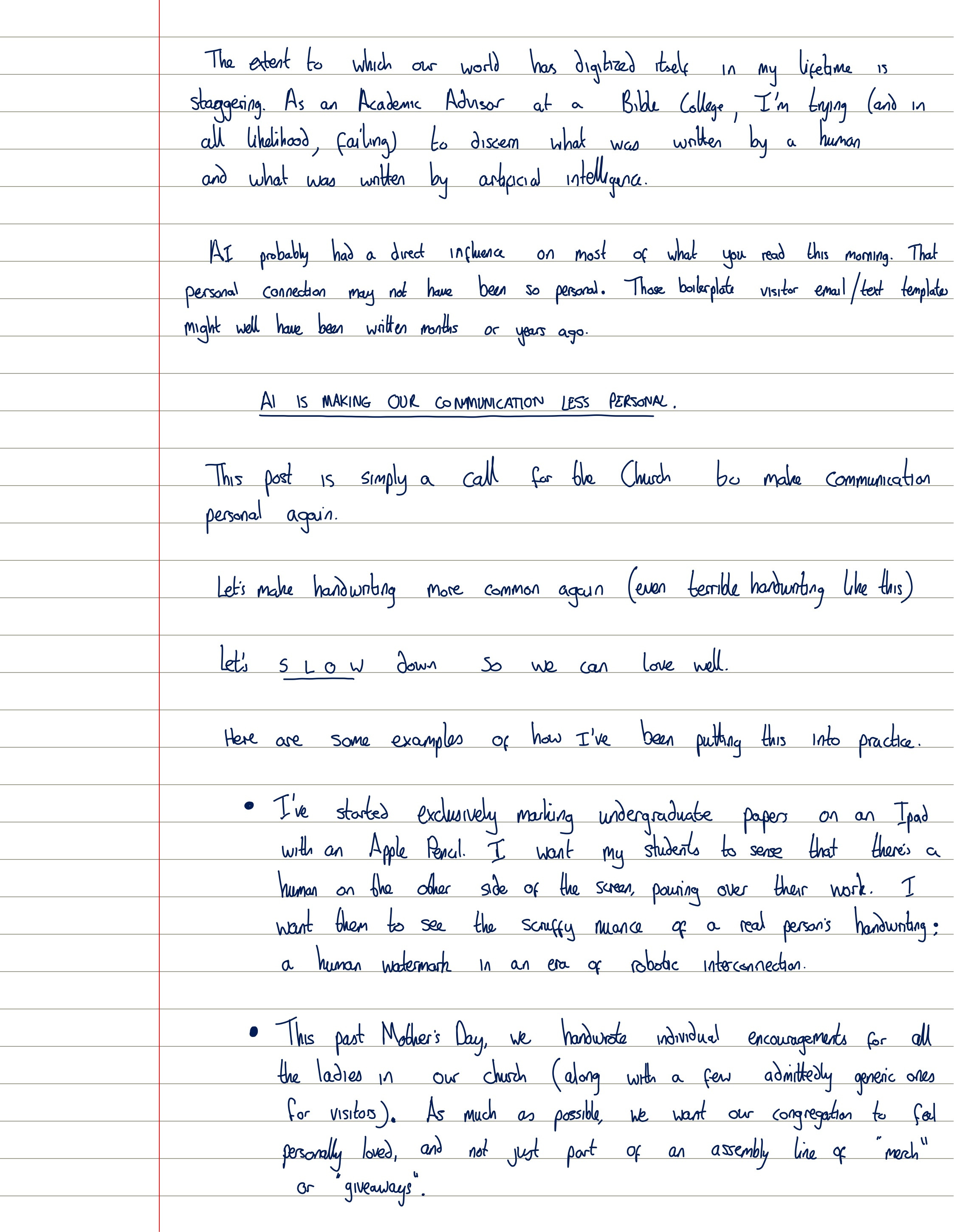
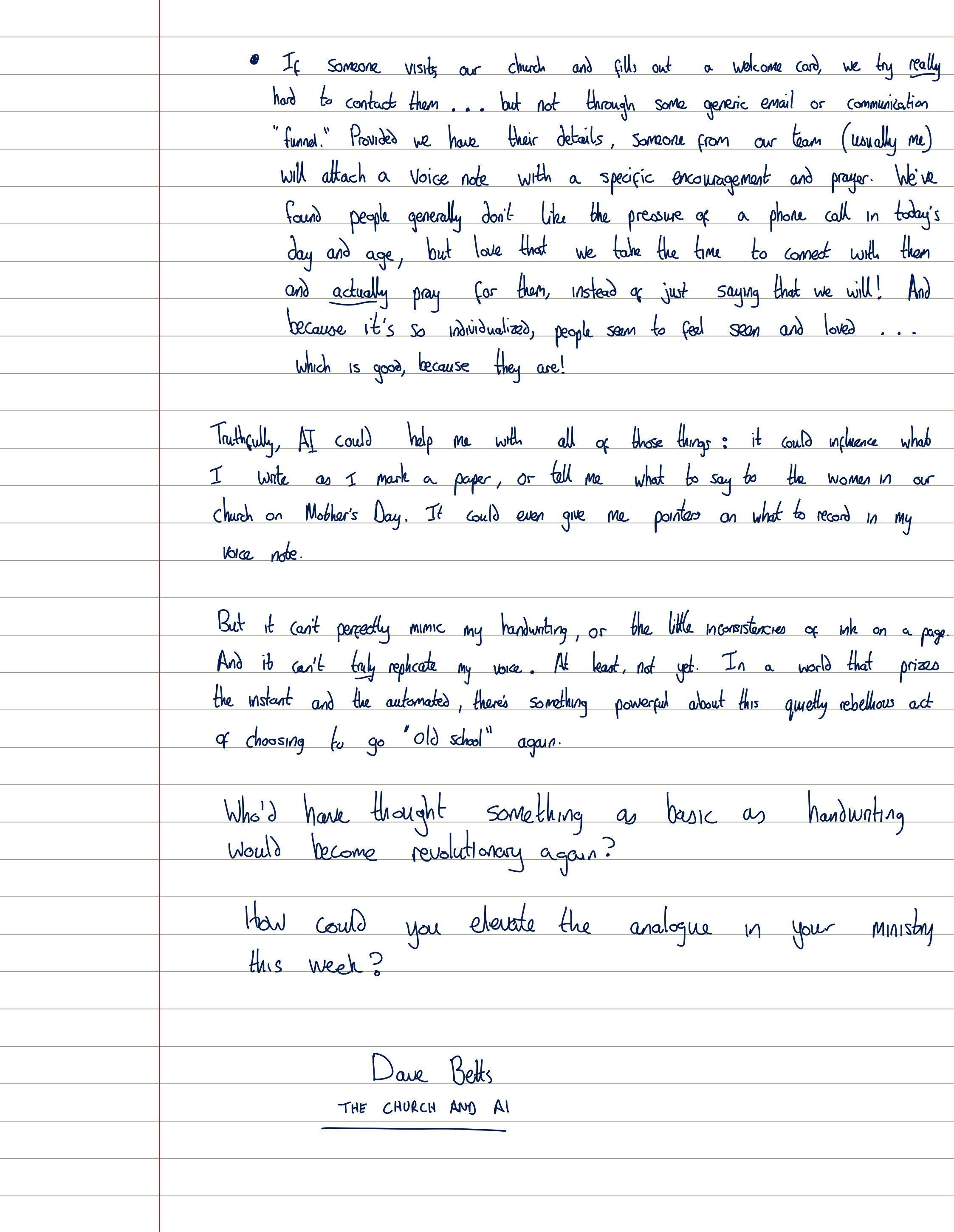
[Typed up for those of you who can’t stomach my handwriting]:
The extent to which our world has digitized itself in my lifetime is staggering. As an Academic Advisor at a Bible College, I’m trying (and in all likelihood, failing) to discern what was written by a human and what was written by artificial intelligence.
AI probably had a direct influence on most of what you read this morning. That personal connection may not have been so personal. Those boilerplate visitor emails/text templates might well have been written months or years ago.
AI is making our communication less personal.
This post is simply a call for the Church to make communication personal again.
Let’s make handwriting common again.
Let’s slow down so we can love well.
Here are some examples of how I’ve been putting this into practice:
I’ve started exclusively marking undergraduate papers on an iPad with an Apple Pencil. I want my students to sense that there’s a human on the other side of the screen, genuinely pouring over their work. I want them to see the scruffy nuance of a real person’s handwriting; a human watermark in an era of robotic interconnection.
This past Mother’s Day, we handwrote individual encouragements for all the ladies in our church (along with a few admittedly generic ones for visitors). As much as possible, we want our congregation to feel personally loved, and not just part of an assembly line of “merch” or “giveaways.”
If someone visits our church and fills out a welcome card, we try really hard to contact them… but not through some generic email or communication “funnel.” Provided we have their details, someone from our team (usually me) will attach a voice note with a specific encouragement and prayer. We’ve found people generally don’t like the pressure of a phone call in today’s day and age, but love that we take the time to connect with them and actually pray for them, instead of just saying that we will! And because it’s so individualized, people feel seen and loved…which is good, because they are.
Truthfully, AI could help me with all of those things: it could influence what I write as I mark a paper, or tell me what to say to the women in our church on Mother’s Day. It could even give me pointers on what to record in my voice note.
But it can’t perfectly mimic my handwriting, or the little inconsistencies of ink on a page. And it can’t truly replicate my voice. At least, not yet. In a world that prizes the instant and the automated, there’s something powerful about this quietly rebellious act of choosing to go “old school” again.
Who’d have thought something as basic as handwriting would become revolutionary again?
How could you elevate the analogue in your ministry this week?

If you found this article helpful, consider reading my book “The Church and AI: Seven Guidelines for Ministry on the Digital Frontiers,” out now! If you’ve read it already, thank you! Feel free to leave a review on Amazon and Goodreads!
I guess I should work on improving my handwriting then!!! 🤓